

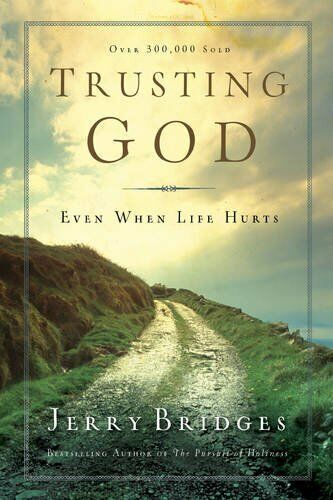
Trusting God, Even When Life Hurts by Jerry Bridges
“No detail of your life is too insignificant for your heavenly Father’s attention; no circumstance is so big that He cannot control it.”
“An unreserved trust of God , when we don’t understand what is happening or why, is the only road to peace and comfort and joy.”
I’ve read and reviewed several books by Jerry Bridges, and like his others, Trusting God is theologically sound and grounded in scripture, and in typical Bridges’ style also very practical. Author, teacher, and speaker Jerry Bridges served in ministry with the evangelistic organization The Navigators for over 50 years before he passed away in 2016. He authored about 20 books, the first and one of his best-known being The Pursuit of Holiness.
Since the Fall, man has had to live with discomfort and pain, loss and sorrow, crime and injustice, and just plain “bad stuff.” Who hasn’t found themselves at some point in their life asking the question, “Why?” to God? Have you ever heard an individual say something like, “God didn’t want this to happen,” when tragedy strikes a family or a community? Is this supposed to be comforting somehow? Or is the person maybe trying to vindicate God, let Him off the hook, so to speak?
In the Preface of Trusting God, Bridges shares his two-fold purpose: “to glorify God by acknowledging His sovereignty and His goodness,” and “to encourage God’s people by demonstrating from Scripture that God is in control of their lives, that He does indeed love them, and that He works out all the circumstances of their lives for their ultimate good.” He starts out at the beginning with giving three truths from Scripture that we must hold to if we are to truly trust God in all things:
- He is completely sovereign.
- He is infinitely wise.
- He is perfect in love.
Bridges proceeds to prove from God’s Word that God is always in control, a truth which should give us great comfort and peace in the midst of trying and painful situations. Certainly more so than consoling ourselves that something occurred outside of God’s will or power. He goes into various areas of life that present challenges, providing examples where we see that God is sovereign and in control over nature, over governments, over people, and in the specific life circumstances in which we find ourselves. God is the Creator of all things, but He didn’t stop with creation; He also continues to sustain and govern all of His creation.
If God were an evil or foolish tyrant, knowing that He is in control would be frightening. We’ve seen throughout human history what can happen when Evil is in charge! But even then, we can take heart. Bridges shares this quote from author Margaret Clarkson:
The circumstances surrounding our lives are no accident: they may be the work of evil, but that evil is held firmly within the mighty hand of our sovereign God…All evil is subject to Him, and evil cannot touch His children unless He permits it.
Some examples of this we find in Scripture include Job and Joseph, and of course the murder of Jesus being probably the clearest example of this. All of these were “victims” of the sins of others, but we can see God’s hand and purpose behind all that took place.
On the other hand, if God were good but not all-powerful, then knowing He is in control would not be comforting either, because no matter how good His intentions were to be, He would be unable to fix problems or help in time of trouble. Bridges writes,
If there is a single event in all of the universe that can occur outside of God’s sovereign control, then we cannot trust Him. His love may be infinite, but if His power is limited and His purpose can be thwarted, we cannot trust Him.
When things go wrong in life, and we wonder Why, we don’t usually get the answer we are looking for humanly speaking. Bridges explains,
To believe in the sovereignty of God when we do not see His direct intervention — when God is, so to speak, working entirely behind the scenes through ordinary circumstances and ordinary actions of people – is even more important, because that is the way God usually works.
Bridges includes some words of caution when it comes to believing and trusting in God and His sovereign work and purposes in our lives. Embracing the doctrine of God’s sovereignty does not mean we do nothing and simply take a fatalistic attitude toward life. We are still expected, in fact commanded, to pray. We still must be faithful and obedient to follow His revealed will. We still must be prudent and wise when making decisions. And I would also add that we are still called to evangelize and to share the gospel with the lost.
Regarding prayer, Bridges observes that “God’s sovereignty does not negate our responsibility to pray, but rather makes it possible to pray with confidence.” Quoting the Puritan Thomas Lye, Bridges shares,
As prayer without faith is but a beating of the air, so trust without prayer [is] but a presumptuous bravado. He that promises to give, and bids us trust his promises, commands us to pray, and expects obedience to his commands. He will give, but not without our asking.
Regarding obedience, I am reminded of one of my children’s favorite hymns growing up, “Trust and Obey.” This hymn reminds us that we walk in this life “in the light of His Word,” doing as He commands (His revealed will), and trusting Him with the outcome (His secret, providential will). Bridges remarks that we are never “to use God’s sovereignty as an excuse to shirk the duties He has commanded in Scriptures…We must depend upon God to do for us what we cannot do for ourselves. We must, to the same degree, depend on Him to enable us to do what we must do for ourselves.”
A person must work to provide for their family; he must be faithful to get up and get to work on time and to do his work as unto the Lord. At the same time, he can be thankful to God for the abilities, gifts, and resources He has given him to enable him to do so.
Regarding prudence, sometimes it’s necessary to do some research to find answers to our questions, or to seek godly, earthly counsel when faced with a difficult decision. Bridges says,
All the wise counsel in the world cannot enable our plans to succeed contrary to the sovereign will of God. But God uses the wise counsel of others to bring our plans into line with His sovereign will.
This doesn’t mean we will never make “mistakes” or bad decisions from a human perspective. But what a blessing and comfort to know that neither man’s advice nor our own choices can ever thwart God’s eternal, pre-ordained purposes!
Believing in God’s sovereignty is not hard as long as life is going along well and according to our plans and desires. It’s when calamity and difficulties arise that we are challenged with our beliefs about God. Have you ever had the thought, “If God is good and sovereign, how could He allow this to happen? Does God even know what He is doing?” Thus, the age-old question, “Why do bad things happen to ‘good’ people?” (Christ actually answered this question in Matthew 19, where He states that no man is good except God.) We may accept that God is sovereign, but we must also learn to rest in the knowledge that in His sovereignty, He is also good and wise and loving. Sometimes this is hard to see, and at such times we must cling to the truths and examples we find in Scripture.
We even may sometimes find ourselves questioning God regarding our own personal circumstances. This could be the family or economical status we are born into, a physical weakness or disability, our current job or living situation, or some other disadvantageous situation we find ourselves in that was outside of our choice or control. The Psalmist praises God for being “fearfully and wonderfully made” in Psalm 139. Bridges shares this quote from George MacDonald:
I would rather be what God chose to make me than the most glorious creature that I could think of; for to have been thought about, born in God’s thought, and then made by God, is the dearest, grandest, and most precious thing in all thinking.
Oh, how much heartbreak and sorrow could be alleviated if more people in today’s culture had this perspective! Again, if we are presented resources and opportunity to improve our circumstances within Biblical, God-ordained means, then we may seek the Lord’s direction, wisdom, and help towards accomplishing this. But we must also learn contentment and be thankful, trusting God to use the circumstances He has placed us in to grow us, to help us to be dependent upon Him, and to glorify Him right where He has us today.
Bridges closes his book with insights about how God uses adversity in our lives for our good and for His glory. He reminds us that God is trustworthy, in both the serious crises we face as well as the trivial, day-to-day matters that can so easily frustrate us. He also reminds us that we need to “give thanks in all things” knowing that God is at work, that He cares for us as His children, and that He will never leave or forsake us.
We can’t help the human tendency to sometimes want to question God, but it is really not helpful or productive at the end of the day. It causes us to focus on the wrong things. Bridges writes,
An unreserved trust of God, when we don’t understand what is happening or why, is the only road to peace and comfort and joy. God wants us to honor Him by trusting Him, but He also desires that we experience the peace and joy that come as a result.
If we truly understand and believe that our God is not only sovereign in ALL things, but also holy, good, loving, powerful, and wise, we can always trust Him and be at peace, even when life is painful and difficult.
Trusting God, Even When Life Hurts is a book I’ve included on my list of non-fiction books I believe every Christian should read. The newest edition contains a study guide with questions for discussion, making it a great book for a small group or Sunday School study.
Other books I recommend by Jerry Bridges include:
- The Pursuit of Holiness
- The Practice of Godliness
- Respectable Sins
- The Joy of Fearing God
- The DIscipline of Grace
- The Gospel for Real Life
Related Articles and Sites
- Books by Jerry Bridges (Navigators.org)
- Jerry Bridges Remembered (Navigators.org)
- Bridges’ 7 Standout Spiritual Lessons (www.challies.com)
- 180 Bridges Quotes (Quotefancy.com)


 I'm All Booked
I appreciate how your faith in God provides such hope and encouragement.