

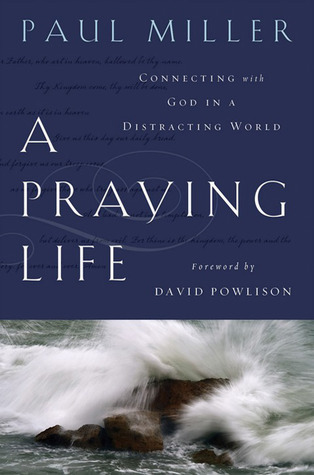
A Praying Life: Connecting with God in a Distracting World by Paul E. Miller
“Prayer does not fit us for the greater works; prayer is the greater work.” – Charles H. Spurgeon
I think it is the rare Christian who can say they honestly believe they pray enough. As my pastor often likes to put it, “God is more ready for us to come to Him than we are to go to Him.” Let’s admit it: Prayer is difficult, at least for most of us. Many Christians don’t have an ongoing, consistent habit, routine, or systematic approach to prayer. They may not know how to integrate prayer into their daily life in a natural way. We fall into formulaic praying that lacks sincerity, wondering if we are really connecting with God, and feel guilty when we find ourselves repeatedly distracted and falling short of some externally imposed standard. We find ourselves thinking more about what to say and maybe how to say it than we do about Who we are talking to. At least, this has been my experience.
As a result of his personal journey towards learning how to pray, Paul Miller’s notes were first turned into a sermon series, then developed into a seminar on prayer, which then evolved into his A Praying Life ministry. His wife and some colleagues then encouraged him to write his book, A Praying Life. In the book, Miller begins with a look at why praying is so hard. Here are some observations he makes:
Our culture values production, achievement, busyness. When we slow down and try to focus on prayer, we may feel like we aren’t being productive with our time. We feel like it is interfering with or detaining us from the work we “should” be doing. We (I) value competency, efficiency, self-sufficiency, and independence. Prayer doesn’t seem necessary if I am able to accomplish in my own strength and way the things I deem to be important. Miller observes that,
Because we can do life without God, praying seems nice but unnecessary…Our trust in ourselves and in our talents makes us structurally independent of God… [On the other hand,] a needy heart is a praying heart. Dependency is the heartbeat of prayer.
Our culture and society are noisy and distracting. Think about it: as you see individuals walking, jogging, driving, or even just waiting in a doctor’s office, how often does it seem that they are either talking on a phone or listening to something with earbuds or on their car stereo? It seems like it is difficult and even uncomfortable to be quiet, let alone to be alone with God. Consider the distractions and demands that surrounded Jesus during His ministerial years. Yet He knew it was important, even vital, to withdraw from people in order to spend alone-time with His Father.
We don’t feel like God is listening or answering, and our relationship and communication with Him feels abstract and distant. But prayer is not about the words we say, but rather about the one with whom we have a relationship. As my relationship with my heavenly Father grows and becomes more intimate, prayer will become easier and more natural. Miller says, “We want an experience with God or an experience in prayer. Once we make that our quest, we lose God. You don’t experience God, you get to know him…He is, after all, a person.”
Any relationship needs time and space to grow. Time must be made for it, just as a husband and wife need to make time to spend intimate alone as a couple. Miller says, “Efficiency, multi-tasking and busyness all kill intimacy.” I need to make specific time to spend alone with God, just focusing on my relationship with Him and getting to know Him better in an undistracted, unhurried space. This continues to be an ongoing challenge for me personally (see Point #1 above).
As Miller moves into the relational aspect of praying, as a child to his father, he looks to Jesus as our example, who, although He was God incarnate, was always totally dependent on His Father and was never too busy to pray. Miller then moves on to examine some of the right attitudes (optimistic, thankful, humble, hopeful) and wrong attitudes (cynical, defeated, doubting) that may help or hinder our prayers. Other topics addressed include:
- What it means to pray “in Jesus’ name”
- Incorporating prayer throughout our daily lives
- Is it okay (or unspiritual) to pray for what I want? And if so, how?
- How to view what is considered “unanswered” prayer – seeing this as part of God’s story playing out in your life
Here are a few additional ideas and quotes that stuck with me:
- “If you are not praying, then you are quietly confident that time, money, and talent are all you need in life…But if, like Jesus, you realize you can’t do life on your own, then no matter how busy, no matter how tired you are, you will find the time to pray…If we think we can do life on our own, we will not take prayer seriously.”
- “Time in prayer makes you even more dependent on God because you don’t have as much time to get things done.” So, the more time I spend in prayer, the more I will have to rely on God to help me accomplish the things that require my time. Thus, prayer causes us to be more dependent on God.
- Jesus’s calls to come to Him are always to the needy: those who hunger or thirst, those who are weary and heavy-laden, those who are weak and have little faith, the sick, distressed, and over-whelmed. If I don’t acknowledge my neediness, I won’t have a reason to come to Him.
- “We don’t need self-discipline to pray continuously; we just need to be poor in spirit. Poverty of spirit makes room for His Spirit.”
- When I understand that God is weaving His story into my life, an isolated incident, problem or concern becomes just part of the bigger picture. Miller says, “Suffering is important to the process of learning how to pray. It is God’s gift to us to show us what life is really like…Gospel stories always have suffering in them…Living in a gospel story exposes our idols, our false sources of love.” Suffering is one means God uses to sanctify us, to draw us to Himself, and to make us more like Christ. Rather than resist or complain against it, we can embrace it as we watch to see what God will do.
- “When you stop trying to control your life and instead allow your anxieties and problems to bring you to God in prayer, you shift from worry to watching.”
- Consider praying aloud. “Praying out loud can be helpful because it keeps you from getting lost in your head. It makes your thoughts concrete…it is also a statement of faith. You are audibly declaring your belief in a God who is alive.
- Don’t be concerned with being articulate or detailed in every prayer. Sometimes a few words are all that needs to be expressed, and I can trust the Holy Spirit to intercede for me. Consider short, “one-breath” prayers like: “Be merciful to me.” “Oh Lord, help me. Give me strength.” “Lord, give me wisdom.” “Lord, calm my heart. Help me not to worry.”
Miller shares a lot of personal examples and stories from his own family that are helpful and insightful. He ends his book with some tips and suggestions of tools you can use to aid in your prayer time, specifically the use of prayer cards (as opposed to a list).
This book caused me to evaluate my own approach to prayer. It gives important reminders as to why prayer is crucial and how God uses it in the life of the Christian. I think it offers many good insights and practical suggestions for those who struggle with incorporating prayer into their lifestyle.
What books, resources, or tools have you found to be helpful in strengthening your personal prayer life?


 I'm All Booked