

 Looking for something good to read? Well, you’ve come to the right place! I love reading, book lists, and recommending great books to others. Please accept my humble reviews and recommendations of Christian, Classic, and Children’s books. Check out my lists of “Books Every Christian Should Read,” and feel free to comment on my articles and to offer some of your own recommendations!

Can God Be Trusted?
Trusting God, Even When Life Hurts by Jerry Bridges
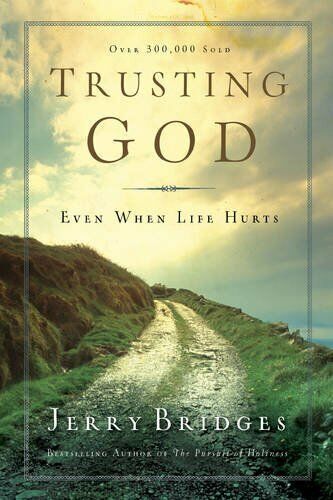
“No detail of your life is too insignificant for your heavenly Father’s attention; no circumstance is so big that He cannot control it.”
“An unreserved trust of God , when we don’t understand what is happening or why, is the only road to peace and comfort and joy.”
I’ve read and reviewed several books by Jerry Bridges, and like his others, Trusting God is theologically sound and grounded in scripture, and in typical Bridges’ style also very practical. Author, teacher, and speaker Jerry Bridges served in ministry with the evangelistic organization The Navigators for over 50 years before he passed away in 2016. He authored about 20 books, the first and one of his best-known being The Pursuit of Holiness.
Since the Fall, man has had to live with discomfort and pain, loss and sorrow, crime and injustice, and just plain “bad stuff.” Who hasn’t found themselves at some point in their life asking the question, “Why?” to God? Have you ever heard an individual say something like, “God didn’t want this to happen,” when tragedy strikes a family or a community? Is this supposed to be comforting somehow? Or is the person maybe trying to vindicate God, let Him off the hook, so to speak?
Continue reading “Can God Be Trusted?”Share this:

Frankenstein: A Contrast in Creators
Frankenstein, or The Modern Prometheus (1818) by Mary Shelley

“I saw—with shut eyes, but acute mental vision— the pale student of unhallowed arts kneeling beside the thing he had put together. I saw the hideous phantasm of a man stretched out, and then, on the working of some powerful engine, show signs of life and stir with an uneasy, half-vital motion. Frightful must it be, for supremely frightful would be the effect of any human endeavor to mock the stupendous mechanism of the Creator of the world.“
There are a number of themes and ideas that are conveyed in Mary Shelley‘s famous story, Frankenstein. One is the dangers of having an overly ambitious thirst for knowledge and power to the neglect of human relationships. Another is the injustice of judging others based on their outward appearance rather than their heart. But one of the ideas that kept coming to my mind as I read Frankenstein this second time around was how Victor Frankenstein’s dealings and relationship with his creature contrasts with God and how He deals with man as His creature.
The story starts out with Victor Frankenstein envisioning himself in a God-like role as a creator of life. In his ambition, he is motivated by the glory he would attain, and the devotion his creation would owe to him: “A new species would bless me as its creator and source; many happy and excellent natures would owe their being to me. No father could claim the gratitude of his child so completely as I should deserve theirs.”
When men try to become God, it never turns out well! In contrast to God’s declaration after creating Adam that all that He had made was “very good,” Victor Frankenstein writes in his journal, “I had been the author of unalterable evils.” After Victor sees that the creature to whom he has given life is ugly and deformed, rather than having compassion on him and desiring to maintain, and later reconcile, their relationship, he rejects the Creature outright, and eventually seeks to destroy him. Throughout the story, Frankenstein refers to his creation as a “demon,” “fiend,” “devil,” and “monster.” He never gives him a personal name or does anything to instill in him an element of humanity. The Creature, on the other hand, is continually reaching out to the world around him in search of understanding, kindness, acceptance, and a sense of belonging. It is only because of the constant rejection he experiences that he becomes alienated from society and retaliates in anger and hatred, eventually seeking revenge against his creator whom he feels is ultimately to blame for his exclusion from society and his miserable existence.
God made man as a social creature; one of His first acts after creating Adam was to give him a “helpmeet” or life partner – another creature that was alike in important ways, yet different and complimentary to Adam. “And the Lord God said, ‘It is not good that man should be alone; I will make him a helper comparable to him” (Gen. 2:18). God knew that this was both needed by Adam as well as beneficial to him. Before Eve was given to him, Adam found no creature like him among the animals he named and was surrounded by. Frankenstein’s Creature likewise sensed that he was different – something “other” than the creatures he encountered. The Creature makes the observation,
I found myself similar yet at the same time strangely unlike to the beings concerning whom I read and to whose conversation I was a listener. I sympathised with and partly understood them, but I was unformed in mind; I was dependent on none and related to none…Satan had his companions, fellow-devils, to admire and encourage him; but I am solitary and abhorred.
He came to realize that he needed and desired a companion that was like him, and he appeals to Dr. Frankenstein to create for him such a being. He pleads his case with Dr. F:
“I am alone and miserable, man will not associate with me, but one as deformed and horrible as myself would not deny herself to me,” he tells Victor. “My companion must be of the same species and have the same defects. This being you must create.”
But Frankenstein denies him this, causing the creature to feel even more alone, isolated, and bitter. The Creature in Shelley’s story blames his creator for his lonely existence. He says to Frankenstein, “Yet you, my creator, detest and spurn me, thy monster, to whom thou art bound by ties only dissoluble by the annihilation of one of us.” As a result of his failure to respond to the needs of his creature, Victor Frankenstein makes an enemy of him, resulting in the eventual loss of those most dear to him, and becoming the victim of his creature’s wrath.
As God’s creatures, we by nature continually seek for understanding, acceptance, and love from the world around us. Meanwhile, we neglect, spurn, and even hate the Creator who gave us life. Yet in His compassion, our Creator seeks out those who ignore and hate Him, and rather than desiring to destroy us (as Frankenstein does his creature), He sent His own Son to die for His enemies in order to reconcile them to Himself and to make them His own children. Romans 5:10 says “…while we were enemies we were reconciled to God through the death of His Son.” God makes those who were at enmity with Him to be His children. He loves the unlovable, becomes a Father to them, and makes them His heirs. In order to accomplish this, His son, Jesus, willingly took on the wrath that deservedly should have been extended to His rebellious creatures. However, in the end Jesus emerges, not as a victim like Victor Frankenstein, but rather as the conqueror who overcomes both His and our enemies: Sin, Death, and Satan.
Have you read Shelley’s Frankenstein? What was your impression of it?
Related Pages and Articles
- Project Gutenberg e-Book of Frankenstein (www.gutenberg.org)
- The Life and Works of Mary Wollstonecraft Shelley
- 6 Things I Never Knew about Mary Shelley’s Frankenstein (www.fee.org)
- Frankenstein at 200 (www.theguardian.com)
Share this:

The First Thanksgiving: The Back Story
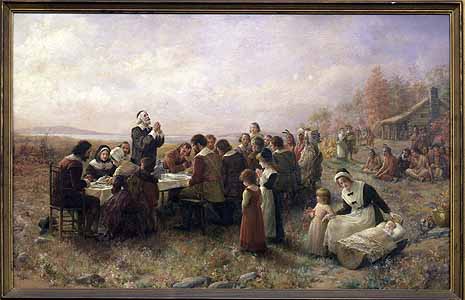
Of Plimoth Plantation by William Bradford
“In this precious volume…is told the noble, simple story ‘of Plimoth Plantation.’ In the midst of suffering and privation and anxiety the pious hand of William Bradford here set down in ample detail the history of the enterprise from its inception to the year 1647. From him we may learn ‘that all great and honourable actions are accompanied with great difficulties, and must be both enterprised and overcome with answerable courages.'” (Roger Wolcott, Governor of Mass., 1897)
by Brownscombe
What American isn’t familiar with the story of the Pilgrims? Well, I think MANY Americans don’t know the whole story, and some people nowadays talk as if it’s nothing but a legend or exaggeration of what really happened. Of Plymouth Plantation
There are only two primary sources which give firsthand accounts of the landing of the Pilgrims and the first Thanksgiving: Bradford’s History (written in 1647) and Mourt’s Relation
Continue reading “The First Thanksgiving: The Back Story”
Share this:

The God Even of Ravensbruck: The Hiding Place
The Hiding Place (1971) by Corrie ten Boom with John and Elizabeth Sherrill

“I know that the experiences of our lives, when we let God use them, become the mysterious and perfect preparation for the work He will give us to do.” (Corrie ten Boom)
“If people can be taught to hate, they can be taught to love. We must find the way, you and I, no matter how long it takes…” (Betsie ten Boom)
At my recommendation, the ladies book club at my church recently read and discussed The Hiding Place. While about half of us had read it before, for most of us it had been a long time (20 years for me), and I was glad to create an opportunity for the others (mostly the younger women) to read it for the first time. One of the gals commented, “At first I wondered why we chose to do a book that so many women had already read. But now that I’m into it, I totally get it!” This is one of those classic works that I believe every Christian – strike that – every person should read.
The story of the ten Boom family was compiled by husband and wife writers, John and Elizabeth Sherrill. The Sherrills had previously written about founder of World Challenge David Wilkerson’s ministry with the gangs of New York City in The Cross and the Switchblade (1963) and God’s Smuggler (1967), the story of the Dutch missionary Brother Andrew van der Bijl, who took the Gospel behind the Iron Curtain. The writing of The Hiding Place came about as a result of the Sherrills meeting Corrie ten Boom in 1968. In the Preface of The Hiding Place, the Sherrill’s describe their introduction to Corrie:
Continue reading “The God Even of Ravensbruck: The Hiding Place”Share this:

The Leaf of Lorien in The Lord of the Rings
The Lord of the Rings Trilogy by J. R. R. Tolkien

“Not idly do the leaves of Lórien fall.“
“One who cannot cast away a treasure at need is in fetters.”
This past weekend I did something I never thought I would do: I got a tattoo (my first and most-likely last!). My daughter has quite a few, and we had talked for a couple of years about getting one together as a mother-daughter thing, but we couldn’t decide on a picture or graphic to use that we both liked. To be honest, we don’t have a lot in common when it comes to interests, music, hobbies, etc., but The Lord of the Rings is something that she and I, in fact our whole family, are big fans of: both the books and the movies. And that ended up being the inspiration for our twin tattoos.
The Lord of the Rings story, while a fantasy set in an alternate world and reality, contains so many themes and Biblical principles about life and what is true. We witness how power can corrupt one’s values and perspective. We see the threat of evil and those who are willing to risk everything to defeat it. We observe the loyalty and dependability of friends who have sworn to stick by each other no matter what, and fight side by side towards a common goal. We watch as characters from different cultures and backgrounds set aside their differences and learn to value one another as individuals and appreciate their uniqueness and worth. We read of normal, inconsequential people achieving greatness simply by being courageous, faithful, and determined to do what is right.
Continue reading “The Leaf of Lorien in The Lord of the Rings”Share this:

The Comfort of Revelation: We are More Than Conquerors!

More Than Conquerors: An Interpretation of the Book of Revelation by William Hendricksen (1939)
“Throughout the prophecies of this wonderful book Christ is pictured as the Victor, the Conqueror… He conquers death, Hades, the dragon, the beast, the false prophet, and the men who worship the beast. He is victorious; as a result, so are we, even when we seem to be hopelessly defeated.“
Have you ever been reading the last book of the Bible and found yourself scratching your head, wondering, What is this actually talking about? Or maybe you’ve just sort of avoided reading it, thinking it’s too hard to understand, or not important or of practical use to your life? I have felt like this at times, and after acquiring a copy of William Hendricksen’s book had always intended to read it sometime. Then when my pastor announced he was starting a sermon series preaching through the book of Revelation, I thought it would be a good time to start it.
The last book of the Bible has been approached and interpreted in many ways, and is often considered to be one of the most difficult and cryptic books in all of Scripture. Yet, the book of Revelation comes with the promise of a blessing to all who read it:
Continue reading “The Comfort of Revelation: We are More Than Conquerors!”Blessed is he who reads and those who hear the words of this prophecy, and keep those things which are written in it; for the time is near (Rev. 1:3).

 I'm All Booked